

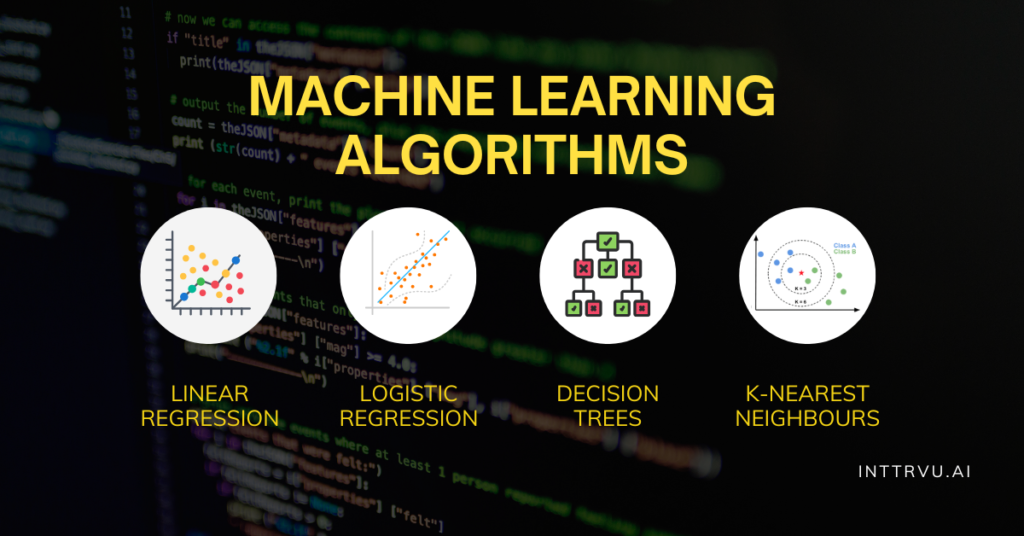
(Expanded with In-Depth Explanation, Projects, and Interview Tips)
A machine learning algorithm is a mathematical model or method that enables computers to learn from and make predictions on data. These algorithms power real-world systems like fraud detection, recommendation engines, forecasting tools, and AI assistants.
But which algorithms matter the most for aspiring data scientists in 2025?
Let’s dive into them one by one.
Definition
Linear Regression is a supervised learning algorithm that models the relationship between a dependent variable and one or more independent variables using a straight line. It’s one of the most fundamental and interpretable ML algorithms.
How It Works
It tries to find the best-fitting linear equation (y = mx + c) that minimizes the error (usually Mean Squared Error) between predicted and actual values using techniques like Ordinary Least Squares.
Project Example: House Price Prediction
When to Use
When Not to Use
Implementation Tip
Use statsmodels for a regression summary with coefficients and p-values, ideal for feature selection.
Interview Tip
Be ready to explain assumptions: linearity, homoscedasticity, independence, no multicollinearity, and normal distribution of errors.
Definition
Logistic Regression is a classification algorithm that estimates probabilities using the sigmoid function and classifies inputs based on a threshold (commonly 0.5).
How It Works
It applies the logistic (sigmoid) function to a linear combination of input features, mapping the output to a probability between 0 and 1. It optimizes the log loss (cross-entropy) during training.
Project Example: Email Spam Detection
When to Use
When Not to Use
Implementation Tip
Normalize inputs and check for class imbalance. Use class_weight=’balanced’ if necessary.
Interview Tip
Know the difference between logistic regression and linear regression, especially the cost function and output interpretation.
Definition
A Decision Tree splits data recursively based on feature values to form a tree-like structure, where each internal node represents a condition and each leaf node represents a prediction.
How It Works
The tree selects features that best split the data using metrics like Gini Impurity or Information Gain (Entropy). It continues splitting until a stopping criterion is met (max depth, minimum samples, or pure leaves).
Project Example: Loan Approval Classification
When to Use
When Not to Use
Implementation Tip
Prune the tree (set max_depth, min_samples_split) to prevent overfitting.
Interview Tip
Be able to manually build a tree from a small dataset and explain impurity measures.
Definition
Random Forest is an ensemble algorithm that builds multiple decision trees on bootstrapped data samples and combines their predictions to improve accuracy and reduce overfitting.
How It Works
Each tree is trained on a random subset of data and features. Final prediction is based on majority voting (classification) or averaging (regression). The randomness and ensemble reduce variance.
Project Example: Employee Attrition Prediction
When to Use
When Not to Use
Implementation Tip
Use feature_importances_ for feature selection or interpretation.
Interview Tip
Explain how bagging and randomness help reduce overfitting compared to a single decision tree.
Definition
XGBoost is a powerful gradient boosting framework designed for performance and scalability. It builds sequential decision trees, where each new tree attempts to correct the errors of the previous ones.
How It Works
XGBoost uses gradient descent to minimize a regularized objective function combining the model’s training loss and complexity. It employs shrinkage (learning rate), column subsampling, and regularization (L1/L2) to reduce overfitting.
Project Example: Customer Churn Prediction
When to Use
When Not to Use
Implementation Tip
Use early stopping and monitor validation error to prevent overfitting. Always scale inputs and use max_depth, eta, and subsample wisely.
Interview Tip
Be prepared to explain boosting vs bagging, and how XGBoost handles missing values natively.
Definition
LightGBM is another gradient boosting framework optimized for speed and efficiency. It uses histogram-based algorithms and grows trees leaf-wise instead of level-wise, leading to faster and often more accurate models.
How It Works
LightGBM creates decision trees using gradient-based one-side sampling (GOSS) and exclusive feature bundling (EFB), which drastically reduce memory usage and training time.
Project Example: Click-Through Rate (CTR) Prediction for Ads
When to Use
When Not to Use
Implementation Tip
Convert categorical features into integers and pass them as categorical_feature to LightGBM for automatic handling.
Interview Tip
Explain leaf-wise growth strategy and how LightGBM differs from XGBoost in both tree construction and speed.
Definition
KNN is a non-parametric, instance-based learning algorithm that classifies new points by finding the ‘k’ closest points in the training set and assigning the majority class.
How It Works
It calculates the distance (Euclidean, Manhattan, etc.) between the input sample and all training samples. The majority label among the k nearest neighbors is chosen as the prediction.
Project Example: Handwritten Digit Classification (MNIST)
When to Use
When Not to Use
Implementation Tip
Use dimensionality reduction (like PCA) before applying KNN to improve performance.
Interview Tip
Be prepared to discuss the curse of dimensionality and the role of distance metrics.
Definition
SVM is a powerful classification algorithm that finds the optimal hyperplane which maximizes the margin between different classes. It’s effective in high-dimensional spaces.
How It Works
SVM constructs a decision boundary (hyperplane) using support vectors (critical points closest to the margin). It can also use kernel tricks to handle non-linear classification (e.g., RBF, polynomial).
Project Example: Fake News Detection
When to Use
When Not to Use
Implementation Tip
Scale the features before training, as SVMs are sensitive to feature magnitudes.
Interview Tip
Know how to explain the kernel trick and why SVMs don’t work well on noisy datasets.
Understanding these algorithms is essential, but applying them in interviews and real-world projects is where many professionals struggle. At INTTRVU, we help you:
Whether you’re switching domains or starting fresh, we ensure you’re ready for the real world.
They are used in finance, healthcare, e-commerce, and tech to automate predictions, detect fraud, personalize experiences, and more.
Start with Linear and Logistic Regression to build foundational knowledge before moving to tree-based and ensemble methods.
It depends on your data type, size, target variable (classification/regression), and need for interpretability vs performance.